

Why AI Answers Change Every Time (and How to Track GEO/AIO Progress Anyway)
If you’ve ever asked ChatGPT (or Google’s AI Overviews, or Claude) the exact same question twice and gotten different recommendations, you’re not imagining things.
This is one of the biggest reasons GEO (Generative Engine Optimization) and “AI Optimization” (AIO) is confusing for business owners right now. In traditional SEO, you can at least try to measure progress with rankings. In AI-driven answers, the output can shift run to run, even when nothing about your business changed.
The good news: that doesn’t mean GEO/AIO is pointless. It means you need a different way to think about visibility, and a smarter way to measure progress.
Let’s break down why AI answers change, what SparkToro’s research found, and a practical tracking framework you can use without chasing ghosts.
The SparkToro finding that should reset expectations
SparkToro ran a large study to test how consistent AI tools are when giving lists of brand or product recommendations. Their volunteers ran 12 prompts across ChatGPT, Claude, and Google’s AI experiences nearly 3,000 times, then normalized the recommendations into comparable lists.
The punchline: these AI tools were highly inconsistent.
- SparkToro found there’s less than a 1 in 100 chance that ChatGPT or Google’s AI will produce the same list of recommended brands twice across repeated runs.
- Getting the same list in the same order was even less likely, closer to 1 in 1,000 in their analysis.
- The number of recommendations also varied (sometimes 2–3, sometimes 10+), which makes “ranking position” even less meaningful.
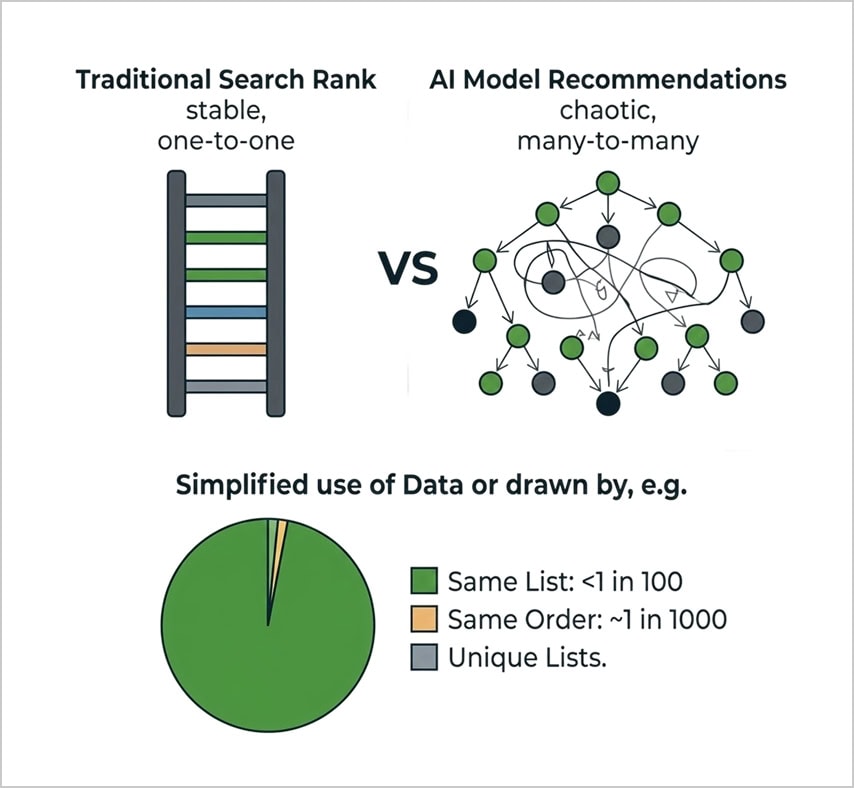
That one study explains why so many business owners feel like GEO/AIO is slippery: if you test “Am I recommended?” once or twice, you can convince yourself of almost anything.
So what do you do instead?
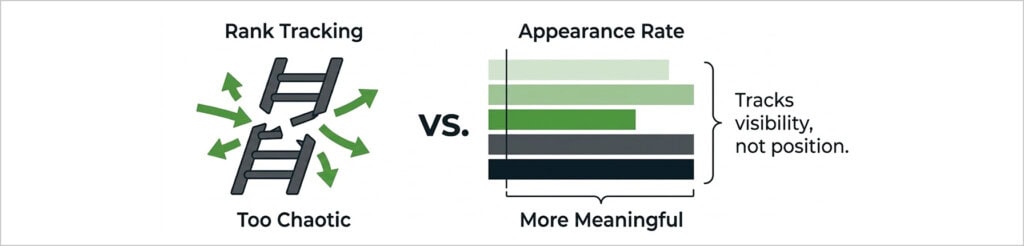
SparkToro’s key takeaway is the right mental model: don’t track “rank.” Track “appearance rate.” They show that even when rankings and order are chaotic, some brands appear in a high percentage of runs for a given intent, and that percentage can be meaningful.

Why AI answers change (even when you don’t change anything)
There are multiple reasons AI tools don’t behave like traditional search rankings. Some are “by design,” and some are “because the world changes.”
1.) Language models aren’t built to repeat themselves perfectly
Many AI systems generate text using probabilistic decoding (sampling). Even small differences in how the system selects the next token can lead to different paths and different lists.
OpenAI explicitly notes that when randomness is present (temperature above 0), variation is expected, and even at temperature 0 you can still see differences in certain situations.
Also, “deterministic settings” in real-world inference aren’t always truly deterministic because of implementation details (hardware, floating point math, parallelism, tie-breaking).
2.) Retrieval and sources can change between runs
Some tools use retrieval-augmented generation (RAG): they fetch or reference outside content and then generate an answer. If the retrieved set shifts (even slightly), the list shifts.
SparkToro also points out that recommendation ordering is not a stable “best-to-worst ranking,” but more like a probabilistic selection and ordering from a candidate pool.
3.) The system is constantly being updated
Models and ranking systems get updated, safety filters evolve, and the underlying web changes daily. Google’s AI experiences, for example, have been expanding and changing presentation and sourcing over time.
4.) Context and personalization factors creep in
Location, previous context, or subtle differences in phrasing can shift results. Even when you think you’re using the “same prompt,” tiny changes like punctuation, added context, or even the way the UI frames the query can alter the output.
That’s why trying to “lock in” one exact prompt is usually a dead end.
The GEO/AIO measurement mistake: treating AI like a 10 blue links leaderboard
A lot of early “AI visibility” talk borrowed SEO language:
- “What position are we in ChatGPT?”
- “Are we #1 in AI Overviews?”
- “How do we outrank competitors in Perplexity?”
SparkToro’s data strongly suggests that ranking position is a trap for recommendations. The results aren’t stable enough, and the list length varies too much for “#1” to mean what people want it to mean.
Instead, the goal should be closer to this:
Increase the probability that your brand appears (and is described accurately) across a set of relevant intents, across multiple tools, over time.
That’s not as sexy as “#1,” but it’s far more measurable and far more real.

A practical way to track GEO/AIO progress (without losing your mind)
Here’s a tracking framework you can implement with a spreadsheet and consistency.
Step 1: Define 8–15 “buyer intent” prompts (not just one)
Pick prompts that reflect the real questions your customers ask, across the funnel.
Examples (adjust to your niche):
- “What’s the best [service] company in [city] for [type of customer]?”
- “Who are the top [category] agencies for [industry]?”
- “Recommend a [service] provider that specializes in [specific problem].”
- “What should I look for when hiring a [service provider]?”
Include:
- 2–4 “near me / local” prompts
- 2–4 “best / top” prompts
- 2–4 “comparison / alternatives” prompts
- 2–3 “how to choose” prompts
This matters because AI answers change, but intent categories give you a stable structure to measure against.
Step 2: Test in batches, not one-offs
If you only run each prompt once, you’re basically flipping a coin.
SparkToro’s research ran prompts 60–100 times per prompt/model to understand variance. You don’t need to go that far to get value, but you do need repetition.
A realistic approach for an SMB:
- Run each prompt 5 times
- Across 2–3 tools (example: ChatGPT + Google AI + one other you care about)
- Repeat weekly or biweekly
That gives you trend lines without turning measurement into a full-time job.
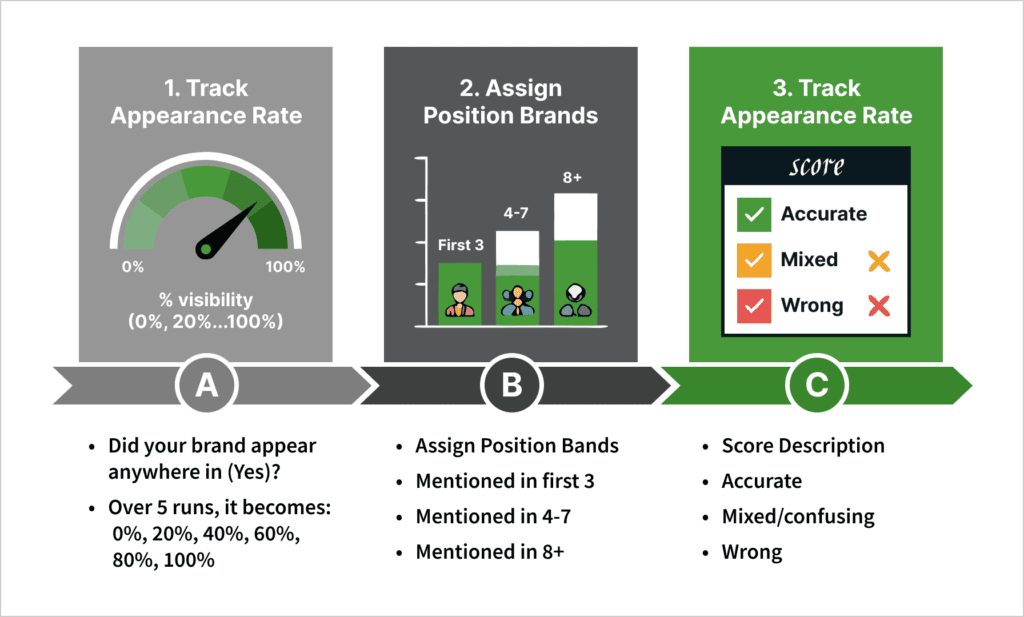
Step 3: Track “appearance rate,” not rank
For each prompt batch, track:
A.) Appearance rate (Visibility %)
- Did your brand appear anywhere in the recommendations? (Yes/No)
- Over 5 runs, that becomes: 0%, 20%, 40%, 60%, 80%, 100%
This aligns with SparkToro’s conclusion that visibility percentage across repeated runs is more meaningful than rank order.
B.) Position band (optional, simplified)
Instead of exact rank, use bands:
- Mentioned in first 3
- Mentioned in 4–7
- Mentioned 8+
It’s less brittle than “we were #2” and still captures whether you’re trending upward.
C.) Description accuracy
Score it quickly:
- Accurate
- Mostly accurate
- Mixed/confusing
- Wrong
This is huge. Being recommended with the wrong positioning can attract the wrong leads (or create trust issues).
Step 4: Add a “share of voice” view
If you can, track:
- How often do you appear compared to 3–5 competitors?
You’re not measuring one output. You’re measuring how often you show up in the AI tool’s “consideration set.”
Step 5: Tie it back to business outcomes (or you’ll optimize the wrong thing)
GEO/AIO metrics are leading indicators. What you actually want is:
- More qualified inquiries
- Better-fit leads
- Higher close rates
- Lower friction in the sales process
So pair your GEO/AIO tracking with:
- Organic lead volume (forms/calls)
- Lead quality notes (CRM)
- Sales cycle length
- Branded search volume trends (if you track that)
If AI visibility increases but lead quality drops, something in your messaging or positioning may be off.

What to do when your results are “inconsistent” (they will be)
Here’s the key mindset shift:
You’re not trying to win one prompt.
You’re trying to become the obvious answer across the web.
That usually comes down to four buckets:
1.) Clarity (make it easy to understand what you do)
AI tools summarize what they can parse.
- Clear service pages
- Strong internal linking
- Explicit “who we help / where we work / what we specialize in”
2.) Consistency (same story everywhere)
Your site, your listings, your profiles, and third-party mentions should reinforce the same entity information:
- Name/brand consistency
- Service categories
- Locations
- Proof points (certifications, years, awards)
3.) Credibility (the web has to back you up)
AI systems tend to be more confident recommending entities with stronger “trust signals,” which often includes off-site corroboration:
- Reviews
- Associations
- Press / local features
- Partner mentions
- Case studies and named results (where appropriate)
4.) Coverage (answer the questions your buyers ask)
GEO/AIO isn’t only about “keywords.”
It’s about being a great source for the kinds of questions that trigger recommendations.
If you publish helpful comparison and “how to choose” content, you give AI systems more surfaces to pull from and cite.

FAQ: the two questions everyone asks after reading this
Does GEO/AIO guarantee we’ll show up in AI answers every time?
No. SparkToro’s research shows recommendation lists are highly variable, even when prompts are identical, so the realistic goal is improving your likelihood of appearing across many runs and many prompts, not “locking in” a single query.
How fast can we see results?
Some improvements (better clarity, better on-site structure) can help quickly. But because AI answers vary and the ecosystem updates constantly, the most reliable way to evaluate progress is over multiple runs and multiple weeks, using appearance rate trends rather than one-time snapshots.
The bottom line
AI answers change because the systems are probabilistic, dynamic, and constantly evolving. SparkToro’s data makes it clear that trying to measure GEO & AIO like SEO rankings is a recipe for confusion.
But if you track GEO/AIO the right way, appearance rate across a prompt set, measured over repeated runs, tied to real business outcomes, you can absolutely make progress and prove it.
Share this post

Newsletter Sign-Up
"*" indicates required fields
We focus on beautiful web design that delivers results for your organization. Our specialty is creating customized WordPress websites.
About Us
Johnny Flash Productions
Johnny Flash Productions is a creative agency based outside of Washington D.C. that focuses on digital strategy, web design and development, graphic design and event production that helps businesses get better results from their marketing.

John has been managing my website SEO and Google Ads for only a few months now and his services have already generated profitable leads. I can’t say enough about his company’s professionalism, promptness and results oriented approach. Hiring his company has been an excellent business decision!!

Johnny Flash Productions is a company that truly cares about their clients, this is obvious by not only their work ethic but they also the way they put their heart into every project they complete.
Johnny Flash Productions was a pleasure to work with, we look forward to working with them again in the future.

I was looking for a web designer who was not only talented, but could deliver - and keep delivering what I needed month after month. The team at Johnny Flash Productions brought ideas to the table that complemented what I wanted to do with my website and their design exceeded my expectations.
I was willing to pay more for their continuing monthly service than I had paid previously because they laid out what I could expect from their team. So far, they have under promised and over delivered.

We were so grateful to have found Johnny Flash Productions to help us with our marketing needs. Their work was above and beyond what we expected. The staff are very competent and great to work with. Excellent results!

Johnny Flash Productions, is an Internet Marketing Industry Expert. I've had the pleasure of interacting with him in a Marketing Mastermind group, and as an industry person, I can say with confidence that John knows his stuff. He's an Expert's expert. His processes are solid, and he knows how to solve problems, and drive leads to your business. He's the real deal.

In a matter of weeks, the Johnny Flash team was able to help Care With Love immensely with ideas as well as practical implementations regarding our website and marketing plans. Their team is professional, responsive, and exemplify great customer service. Well done Johnny Flash Team!

Exceeded all expectations in their abilities to professionally evaluate and customize our company WordPress website. Above all else, their customer service is the best I've dealt with in a long time with any company I've worked with in the past. I definitely recommend Johnny Flash Productions to anyone looking for exceptional service, professional detail and customer support.

I would like to thank Johnny Flash Productions for there great service my company has been able to get to get to the top of Google searches in half the time most companies take. I am now receiving 3 to 5 viable leads a day that all lead to service work for my company. And I can not thank them enough for all of there support with my site and maintaining it for me.

We've worked with John and his team for several years on multiple projects. They deliver great work on time, on budget and with solid ongoing support. We highly recommend Johnny Flash Productions!

I have worked with Johnny Flash Productions on 3 of my own websites and recommended Johnny Flash productions to two other family members who were also in need of new websites. We have all had an exceptional experience during the process.
The staff are very responsive, organized, on time and they follow through until the work is complete. We valued them so much that we use them for our monthly maintenance and they help with our advertising online.

Their knowledge of SEO and integration of social media channels improved our church's online impact.

We had a phenomenal experience working with the Johnny Flash Productions team for our new website, SEO, and logo. We are excited and unequivocally satisfied with the results. Our website has received numerous positive reviews from our clients, associates, and friends. And their SEO services have already brought us new clients who found us online.

We began collaborating with Johnny Flash Productions in January 2023 with the primary goal of optimizing our SEO and achieving visibility on Google's first page. During our initial meeting, John provided thorough explanations and informed us that it could take up to six months to see results. Fast forward, and our company consistently appears on the first page of Google.

I've had an exceptional experience working with Johnny Flesh Productions for my website's search engine optimization. John and his team are not just experts in SEO, but they also make the process engaging and informative. Their prompt responses and unwavering professionalism stand out, making every interaction a pleasure. If you're looking for a team that delivers outstanding results and values client collaboration, Johnny Flash Productions is the go-to choice. Five stars all the way!"

JFP is amazing. My new website is very clean, conveys exactly what I want to my clients, looks way better than the competition, and will be the base for my company moving forward. And now I have a great working relationship with Johnny Flash Productions for all of my SEO and website needs. Don't hesitate to go with JFP, they're honest. They rock!
We love working with Johnny Flash! Their team is always helpful, prompt, and makes the process of everything we're doing a lot easier. From designs to social media, and their support team are all amazing! Thank you!

Universal Athletic Club in Lancaster Pennsylvania has been working with Johnny Flash Productions for years. We were in need of a complete website redesign and after researching our options decided to have JFP take on the project.The new design is very consistent throughout, with all of the pages clean, modern and easy to read. Universal has an extensive amount of offerings, with many diff. audiences, which made the arrangement of information crucial to the success of the project. This new site appeals to the average person making everything very easy to find. Everything was done in a professional, business like manner with lots of interaction from pre-planning through post launch edits of the new website. JFP also takes care of our Google ads and website SEO. Having a knowledgable and responsive company to work with has been a wonderful addition to our ever changing marketing strategies.

We’ve had the pleasure of working with Johnny Flash for the past couple of years. From designing and managing our website to optimizing our SEO and assisting with marketing efforts, they’ve consistently gone above and beyond. Their team is incredibly knowledgeable, responsive, and dedicated to helping us grow. Whenever we have a question or need support, they’re quick to provide solutions and always offer excellent guidance. We highly recommend Johnny Flash to anyone looking for a professional, reliable, and supportive digital marketing partner.

Amazing company to work with from start to finish. From Joli and the web design team to dealing with John directly these guys are true professionals. Couldn't be happier with our results and highly recommend.
We’ve been working with Johnny Flash for years, and they’ve consistently done an outstanding job for us. Their expertise and dedication shine through in everything they do. We trust their input and value their opinions when it comes to our website and social media presence. It’s always a pleasure collaborating with them, and we highly recommend their services without hesitation!

If you need a graphic design team, Johnny Flash is a helpful partner to have on hand. Their work is professional and creative. Their Project Manager was a true Godsend for us personally, keeping every project on schedule with grace and a smile!